• FSK Corrosion-Resistant Water-Ring Vacuum Pump,MY SHOP,FSK Corrosion-Resistant Water-Ring Vacuum Pump
  • FSK Corrosion-Resistant Water-Ring Vacuum Pump,MY SHOP,FSK Corrosion-Resistant Water-Ring Vacuum Pump
  • FSK Corrosion-Resistant Water-Ring Vacuum Pump,MY SHOP,FSK Corrosion-Resistant Water-Ring Vacuum Pump
  • FSK Corrosion-Resistant Water-Ring Vacuum Pump,MY SHOP,FSK Corrosion-Resistant Water-Ring Vacuum Pump
  • FSK Corrosion-Resistant Water-Ring Vacuum Pump,MY SHOP,FSK Corrosion-Resistant Water-Ring Vacuum Pump
  • FSK Corrosion-Resistant Water-Ring Vacuum Pump,MY SHOP,FSK Corrosion-Resistant Water-Ring Vacuum Pump

FSK Corrosion-Resistant Water-Ring Vacuum Pump

Xin’anjiang IIFSK/2FSK corrosion-resistant water-ring vacuum pumps are patented products developed by our company. They feature strong corrosion resistance, high ultimate vacuum, and large pumping capacity, and are widely used in vacuum evaporation, filtration, drying, concentration, distillation, and crystallization across food, petroleum, chemical, pharmaceutical, metallurgical, and electronics industries. Suitable for various gases and corrosive gases without solid particles.
Download
View all downloads
  • FSK Corrosion-Resistant Water-Ring Vacuum Pump,MY SHOP,FSK Corrosion-Resistant Water-Ring Vacuum Pump
  • FSK Corrosion-Resistant Water-Ring Vacuum Pump,MY SHOP,FSK Corrosion-Resistant Water-Ring Vacuum Pump
  • FSK Corrosion-Resistant Water-Ring Vacuum Pump,MY SHOP,FSK Corrosion-Resistant Water-Ring Vacuum Pump

Description

  Product Overview  

The Xin'anjiang-brand IIFSK/2FSK series corrosion-resistant water-ring vacuum pumps are a new generation of patented products independently developed by our company. Integrating technologies such as corrosion-resistant materials and high-vacuum capabilities, these pumps feature exceptional corrosion resistance, a high ultimate vacuum level, and high pumping capacity.


  Product Features  

    This product integrates technologies such as corrosion-resistant materials and high-vacuum capabilities, featuring strong corrosion resistance, a high ultimate vacuum level, and a large pumping capacity.

        Intended Use  

        This pump is widely used in processes such as vacuum evaporation, filtration, drying, concentration, distillation, and vacuum crystallization across the food, petroleum, chemical, pharmaceutical, metallurgical, and electronics industries. It is suitable for handling various gases, including corrosive gases that are free of solid particles.

        In practical applications, water-ring pumps are frequently employed for processes such as vacuum drying, vacuum material transfer, negative-pressure dust removal, distillation and filtration, and vacuum crystallization.

          Working principle of the liquid-ring vacuum pump 

          When the impeller of the water-ring vacuum pump rotates clockwise (as shown in the diagram), water is thrown outward by the impeller; due to centrifugal force, the water forms a closed ring of approximately uniform thickness that conforms to the shape of the pump chamber.

          The inner surface of the lower part of the water ring is tangent to the impeller hub, while the inner surface of the upper part of the water ring makes contact with the tips of the blades (in practice, the blades extend a certain depth into the water ring).

          This arrangement creates a crescent-shaped space between the impeller hub and the water ring, which is further divided by the impeller blades into a series of small chambers equal in number to the blades.

          Taking the 0° position at the bottom of the impeller as the starting point: as the impeller rotates through the first 180°, the volume of each small chamber expands, and the chamber connects to the intake port on the end face, drawing in gas; once the intake phase ends, the chamber is cut off from the intake port.

          As the impeller continues to rotate, the volume of the small chamber contracts, compressing the gas; when the chamber aligns with the exhaust port, the gas is discharged from the pump.

          The water-ring vacuum pump features an eccentric rotor equipped with fixed blades. It operates by throwing water (or liquid) against the stator wall to form a liquid ring concentric with the stator; this liquid ring and the rotor blades together create variable-volume spaces, making it a type of rotary variable-volume vacuum pump.


          Guidelines for Selecting Water-Ring Vacuum Pumps  
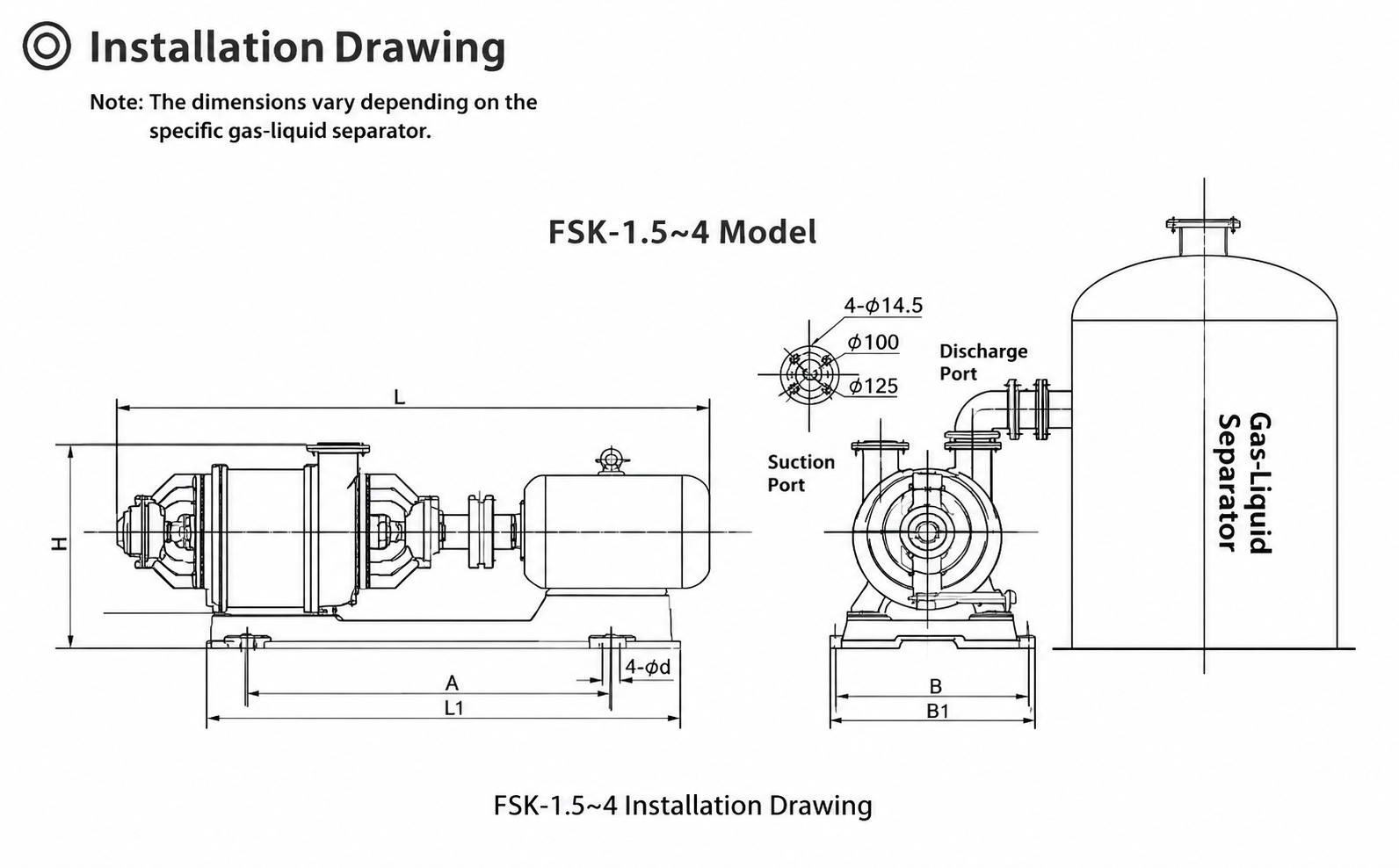
            Water-ring vacuum pump models are typically designated in the format "II FSK - 8," where the parameters signify the following:

            II — Second-generation water-ring pump

            F — Corrosion-resistant

            SK — Water-ring vacuum pump

            8 — Maximum pumping capacity (m³/min)

              Water-ring vacuum pump specifications table  


            Product Model

             Maximum pumping capacity (m³/min)


            Ultimate vacuum level

            Power
            (kW)


            Rotational speed (r/min)

            Water consumption (L/min)
            Inlet/Outlet Diameter (mm)
            Rotational speed(r/min)

            Fore-vacuum pump

            power(kW)

            power(r/min)

            Inlet/Outlet Diameter (mm)

            Mpa mmHg
            II FSK-1.5 1.6 0.098 735 3 1440 8 65/65   IIFSK-3 5.5 1450 65/65
            II FSK-2 2.76 0.098 735 4 1440 9 65/65   IIFSK-4 7.5 1450 65/65
            II FSK-3 3.85 0.098 735 5.5 1440 12 65/65   IIFSK-4 7.5 1450 65/65
            II FSK-4 4.68 0.098 735 7.5 1440 15 65/65   IIFSK-6 11 1450 80/80
            II FSK-6 6.1 0.098 735 11 1440 20 80/80   IIFSK-8 15 1450 80/80
            II FSK-8 7.8 0.098 735 15 1440 24.5 80/80   IIFSK-6 11 1450 100/80
            II FSK-12 12.6 0.098 735 22 970 26 125/125 IIFSK-8 15 1450 100/80
            II FSK-16 16.8 0.098 735 30 970 34 150/150 IIFSK-4 7.5 1450 65/65
            II FSK-20 20.4 0.098 735 37 970 36 150/150 1450 IIFSK-6 11 1450 100/80

            Guidelines for Selecting Water-Ring Vacuum Pumps  
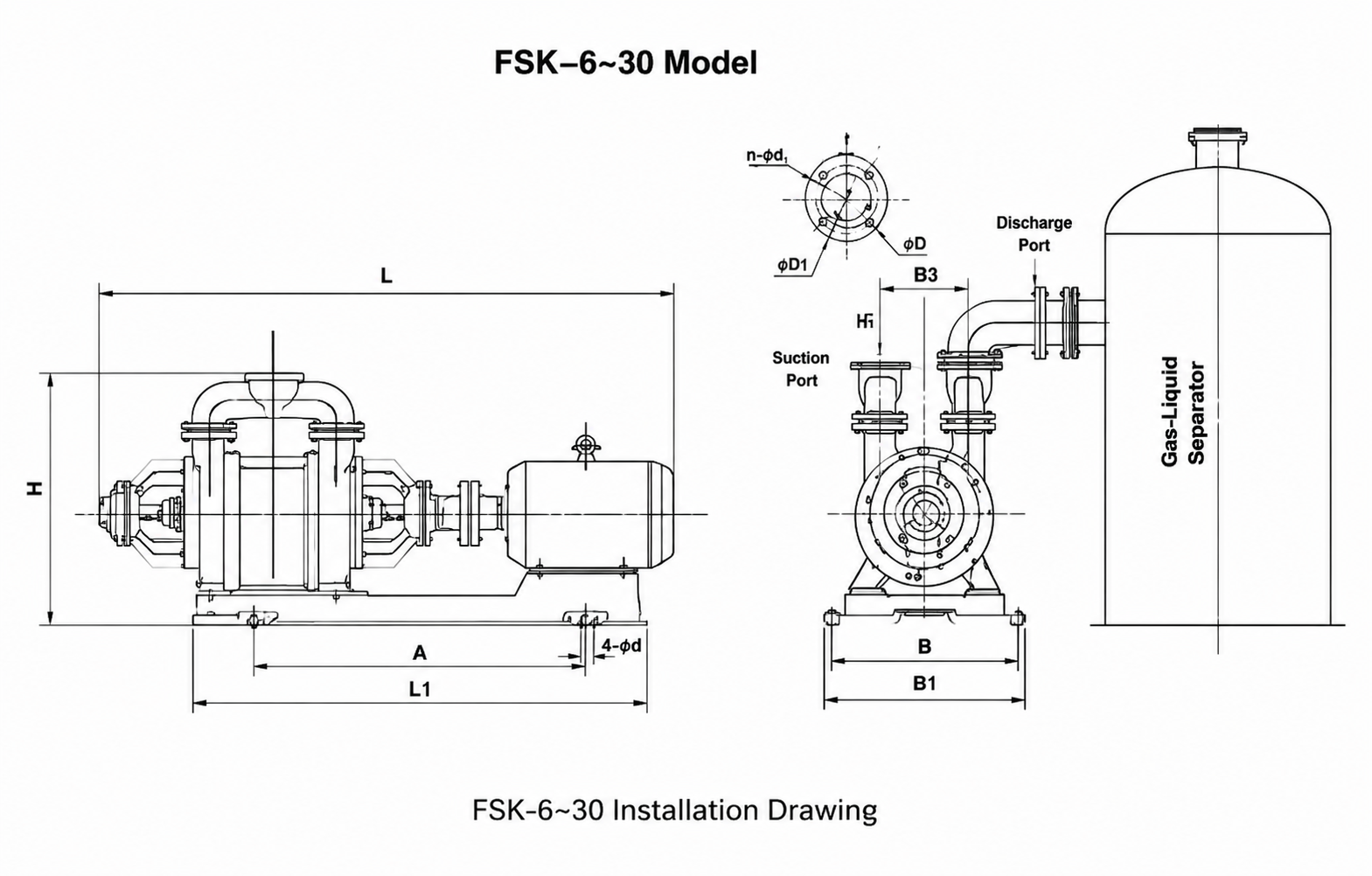
              Notes: ① The performance figures in the table are based on the following conditions: gas temperature of 20°C, atmospheric pressure of 1013.25 hPa (equivalent to 760 mmHg), relative gas humidity of 70%, and circulating water supply temperature of 15°C. 

              ② Pumping speed tolerance: ±10%. 
              ③ The vacuum values ​​in the table represent the pressure level below standard atmospheric pressure. (1 mmHg = 1 Torr = 133.3 Pa; 0.1 MPa = 750 mmHg)


              Request a Quote

              Request a Quote

              Tell us about your project requirements, and our engineering team will provide the most suitable solution, technical support, and a competitive quotation within 24 hours.

              Name*
              Email*
              Phone/Whatsapp
              Company
              Purchasing Requirements*